Best Compression Packing Cubes: The Double-Zip Sets That Actually Shrink Your Pile, and the Trap Nobody Warns You About
Verdict:For most travelers, the Thule Compression Cube Set is the pick, because it drops from 4.3 inches to 1.25 inches deep on YKK zippers that survive real trips. If you want the cheapest way to try compression, buy the $29.99 BAGSMART six-piece set instead.
For most travelers who actually need to fit more into a carry-on, the Thule Compression Cube Set is the compression cube to buy, because its small cube packs at 4.3 inches deep and a second zipper pulls it down to 1.25 inches, and it does it on YKK zippers, the part that takes the most stress on any compression cube. If you just want to see whether compression cubes are worth it before spending $54, buy the BAGSMART six-piece set for $29.99 instead.
A compression cube is not the same product as a regular packing cube, even though they look alike on a shelf. A regular cube organizes: it keeps your shirts in one block so you can find them. A compression cube has a second zipper that squeezes the air out and shrinks the pile itself. If you already own organizers and your problem is not “where is my stuff” but “it does not fit,” this is the subcategory you want. If you want the full picture on organizers versus compressors, our best packing cubes roundup covers both; this page is only about the ones that shrink.
Some links in this article are affiliate links. If you buy through them, we earn a small commission at no extra cost to you. We only link to products we would actually recommend. If it does not hold up in real use, it is not here.
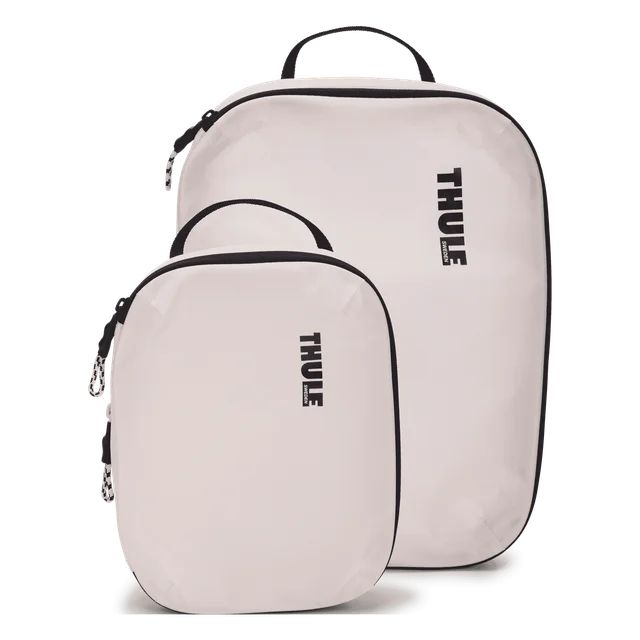
This is the set to buy if you want the most reliable compression. The two-piece set costs $53.95 and does the one thing that separates compression cubes from organizers. The small cube packs at 10.2 by 7.1 by 4.3 inches (26 by 18 by 11 cm), then the second zipper pulls it down to 1.25 inches deep (about 3 cm). That is a real reduction you can measure, not a marketing number. The shell is 100D ripstop nylon, bluesign-approved, the small cube weighs 0.46 lb (209 grams), and the zippers are YKK, which matters most here because the compression zipper is the part under the most load.
The reason this set wins is durability under compression. Pack Hacker put it among “some of the better compressing models we’ve tested,” and separately praised Thule for “durable compression zippers that don’t get caught on clothes,” which is precisely the failure that ends cheaper cubes.
The honest negative is the price and the two-piece count. At $53.95 you get a small and a medium, not a full four-cube set, so a heavy packer may want two sets. And like every compression cube, a fully stuffed cube takes two hands to close, because the second zipper is fighting the air you are trying to remove. That is the trade for a cube that actually holds its compression.
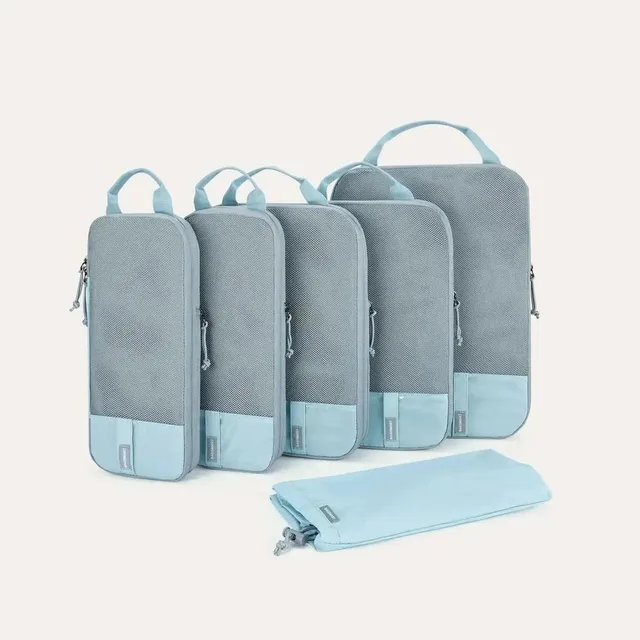
The BAGSMART set is the compression pick if you want the most cubes for the least money. Six pieces for $29.99 is roughly half the price of the Thule two-piece, and the design is the same double-zip idea: pack the cube, then run the second zipper to squeeze it flat. A tester for a Yahoo Shopping roundup, which named it best overall, said “I was pretty shocked to see how much the second zipper shrunk down my clothing,” which is the reaction you want from a $30 set.
The reason it earns a place next to the Thule is coverage. Six cubes in a range of sizes let you sort a whole trip, shirts, underwear, socks, chargers, and compress each block, where the Thule gives you two.
The honest negative is the one that explains the price gap. Budget compression cubes generally use thinner fabric than the Thule’s 100D ripstop, and the recurring complaint across cheaper sets is fabric catching in the compression zipper, which wears the shell over time. Close the compression zipper slowly and keep loose fabric clear of the teeth. Buy these to try compression across a whole trip cheaply; if you travel weekly, the Thule’s heavier shell and YKK zippers will outlast two of these.
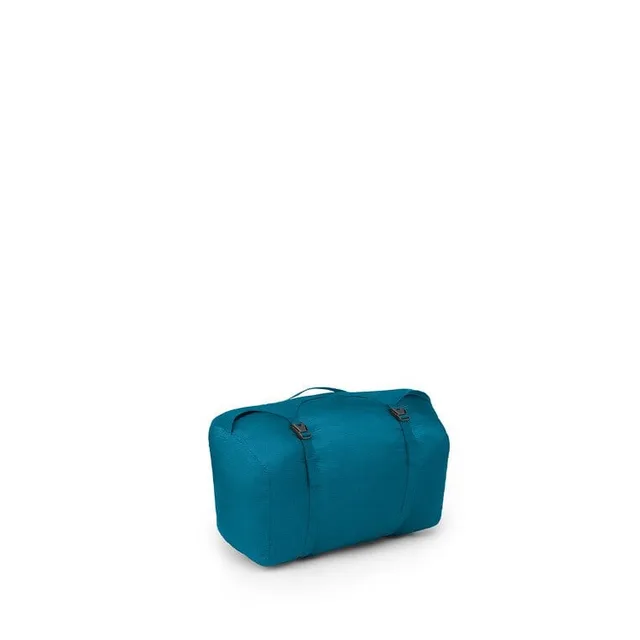
The Osprey StraightJacket is the pick if your problem is a bulky, soft load, jackets, a puffy, a towel, more than it is sorting outfits. It is a compression sack, not a cube: you stuff it, then cinch it down with straps and YKK buckles instead of a zipper, which is a stronger way to squeeze a big soft pile. The 12L sits around $30, the shell is recycled 40D high-tenacity nylon, and it is water-resistant, which the fabric cubes above are not.
The reason it belongs here is the compression method. Pack Hacker, which named it a best value, said it “excels at getting clothing from point A to point B in a tiny package,” and buckle-and-strap compression handles bulky soft goods better than a zipper that has to fight a full cube.
The honest negative is that it is not an organizer. A sack has no internal structure, so you cannot lay out outfits or find one shirt without unpacking, and it makes a rounded shape rather than a flat block that stacks neatly in a suitcase. Buy this for a puffy jacket or a one-bag load you compress as a unit; buy a cube if you want to sort and find things.
This is the part most roundups skip, and it is the one that ruins trips. A compression cube squeezes out air. It does not remove a single gram. Your ten shirts weigh exactly the same compressed as loose, so the scale at the check-in desk reads the same. The danger is what the freed space tempts you to do: one-bag travelers report that once a cube “shrunk down” their clothes, “I had more space in my luggage, so I added more, and eventually my bag became heavier.” If your airline enforces a weight limit, not just a size limit, a compression cube can push you over it by inviting you to fill the room you just made. The r/onebag consensus is blunt about it: compression cubes “don’t make a suitcase bigger,” and the real value shows up “primarily for carry-on and one-bag travelers” who use the space to close a smaller bag, not to pack more into a bigger one.
The decision
If you want the most reliable compression, buy the Thule Compression Cube Set. A real drop from 4.3 inches to 1.25 inches deep on YKK zippers, in a 100D ripstop shell, for $53.95.
If you want the cheapest way to compress a whole trip, buy the BAGSMART six-piece set. Six double-zip cubes for $29.99, as long as you accept thinner fabric and zip the compression slowly.
If your load is bulky soft goods, buy the Osprey StraightJacket 12L sack. Buckle-and-strap compression in a water-resistant 40D nylon sack, around $30, as long as you do not need internal organization.
Whatever you buy, remember the trap. Compression frees space, not weight. If your airline weighs bags, do not let the extra room talk you into overpacking.
Airalo vs Holafly compared on real USD prices for Japan, Thailand, and Vietnam, daily data caps, hotspot rules, and who each eSIM is right for.
Verdict: Buy Airalo for most trips: it was cheaper than Holafly on every unlimited duration we checked in Japan, Thailand, and Vietnam, it sells fixed-GB plans that cost far less for light use, and it publishes its daily full-speed cap. Buy Holafly only if you want unlimited data sold by the exact day, from 1 to 90 days, and accept paying from $0.50 to about $25 more.
Airalo vs Saily compared on live prices, coverage, calls, apps, support, and Trustpilot scores, with a clear pick for each kind of trip.
Verdict: Airalo is the better default because its prices match Saily's almost to the cent and it adds calls and SMS plans, 3 to 365 day validity, and wider regional coverage. Saily is the better pick if you want a single reusable eSIM, faster in-app support, and a much higher Trustpilot score (4.7 against 4.1).
Anker power bank review for travelers: Laptop 25K 165W, Prime 26K 300W, MagGo 10K Slim and Nano 5K compared by weight, price, Wh, and the recall list.
Verdict: For most travelers carrying a laptop, the Anker Laptop Power Bank (25K, 165W) is the Anker to buy, because it pairs 92.5Wh of capacity with two built-in cables for $119.99. If you only charge an iPhone, buy the MagGo 10K Slim or the Nano 5K instead.