ESIM for International Travel: How to Choose
Compare eSIM coverage, data plans, prices, activation, and limits to choose an eSIM that fits your international trip.
Verdict: For most travelers, the Epicka TA-105 Pro (70W GaN, 6 ports) is the type-C travel adapter to buy, because it charges a laptop faster than any 65W rival here while costing less at $49.99. If you want the lightest, safest option for a family, the 168-gram Zendure Passport III is the pick instead.
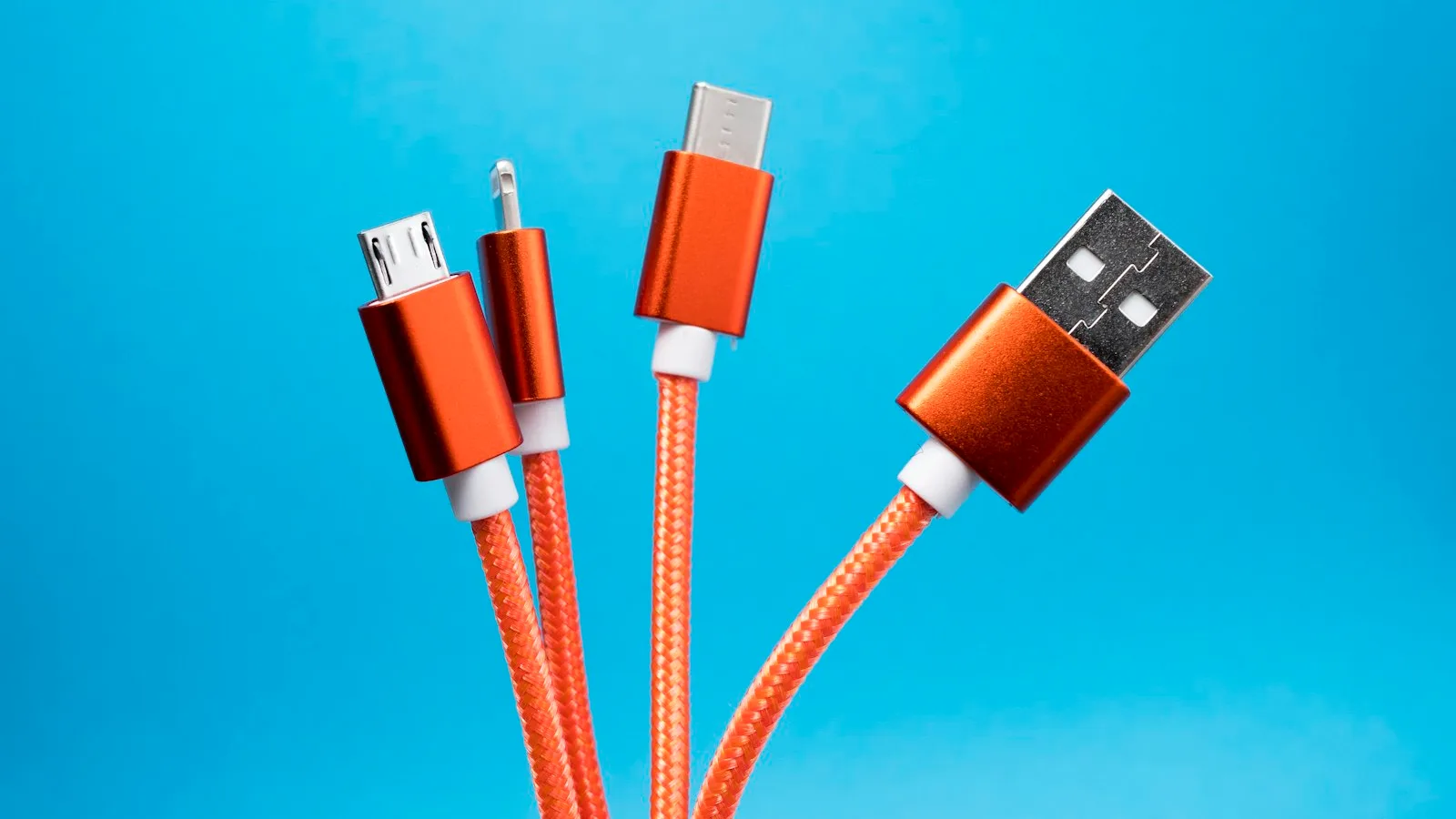
The best type-C travel adapter for most people in 2026 is the Epicka TA-105 Pro, a 70W GaN unit with six ports, because it charges a laptop faster than any 65W rival in this roundup while costing less at $49.99. If you want the lightest and safest option, especially traveling with kids, buy the 168-gram Zendure Passport III with its child-safe prongs instead. Everything else here is a variation on those two decisions.
The number that actually separates these adapters is not the plug shape. Every one converts a US, UK, EU, or Australian outlet. What separates them is how many watts the top USB-C port delivers, because that is what decides whether your laptop charges at a usable speed or crawls overnight. One warning first: a travel adapter changes the plug shape, it does not convert voltage. Your devices must be dual-voltage (rated 100 to 240V), which nearly all laptops, phones, and camera chargers are, but a US hair dryer is not.
Some links in this article are affiliate links. If you buy through them, we earn a small commission at no extra cost to you. We only link to gear we would actually pack. Prices below were live on the brands’ own pages on August 17, 2026, and can change, so confirm before you buy.
Three specs decide this, and the marketing buries all of them under “universal.”
Top USB-C wattage. This is the whole game. A 65W or 70W USB-C port charges a 13-inch or 14-inch laptop at close to its wall-adapter speed. Drop to 30W and you are topping up a phone while your laptop sits nearly dead. Every adapter here clears 65W on its main port, which is the floor for laptop travel.
GaN, not silicon. Gallium-nitride chargers run cooler and pack the same wattage into a far smaller body. Every pick here is GaN, which is why a 70W unit now fits in a jacket pocket.
Plug coverage. All four cover US, UK, and EU. The gap is Australia (Type I), which the Epicka and Zendure include but the Ugreen does not. None of these four cover India’s Type D or South Africa’s Type M, so if you are headed there, check before you rely on one.
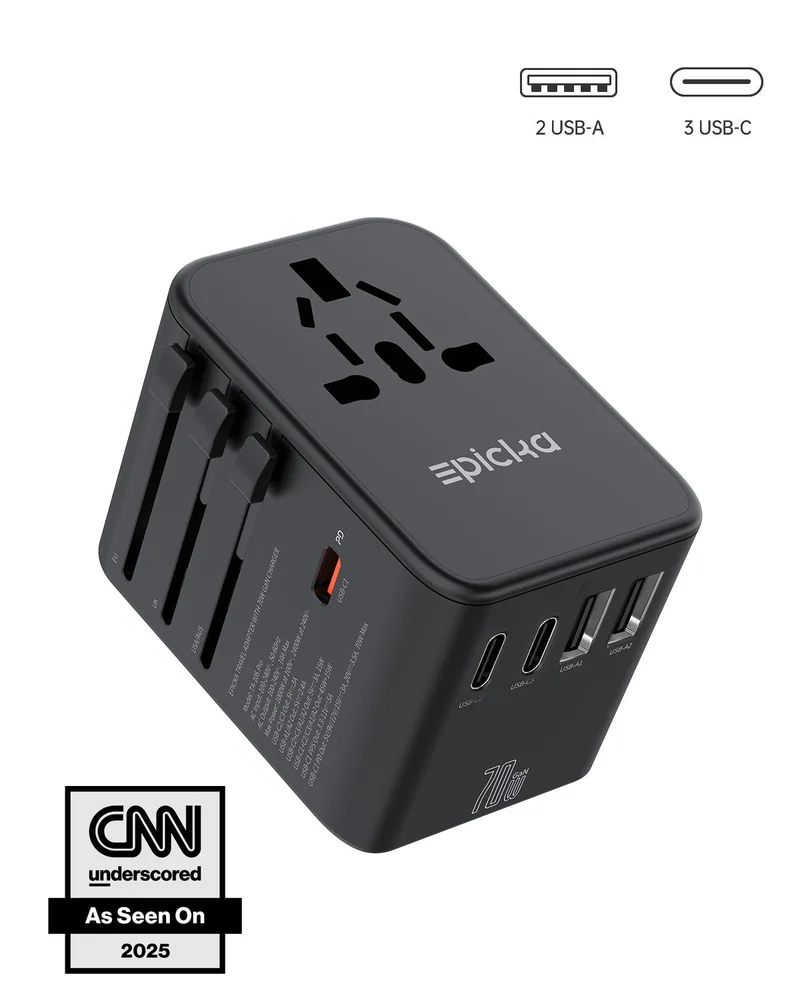
Photo: Epicka
This is the adapter to beat, because it delivers the most laptop-charging power of the group for the lowest price. Its top USB-C port pushes 70W (20V at 3.5A), enough to fast-charge a 13-inch or 14-inch laptop, and it carries six connection points in total: three USB-C, two USB-A, and the universal AC pass-through, so you can charge a laptop, a phone, earbuds, and a tablet at once. It weighs 236 grams (8.32 oz) and includes built-in EU, UK, US, and Australian plugs covering 200-plus countries.
The output is where it earns the pick. In independent testing surfaced across reviews, the TA-105 Pro charged a 2023 MacBook Air to 50 percent in 32 minutes, against 68 minutes for an Anker Nano, and took a 13-inch MacBook Pro from 20 to 80 percent in about 50 minutes. That is the difference between charging over a coffee and charging overnight.
The honest negatives. It is a single-piece all-in-one with the plugs built in, so it is chunkier in a bag than a folding design, and its plug set skips India’s Type D and South Africa’s Type M. It is also not a voltage converter, so it will not run a non-dual-voltage appliance. At $49.99 it undercuts both 65W rivals here while giving you more wattage.
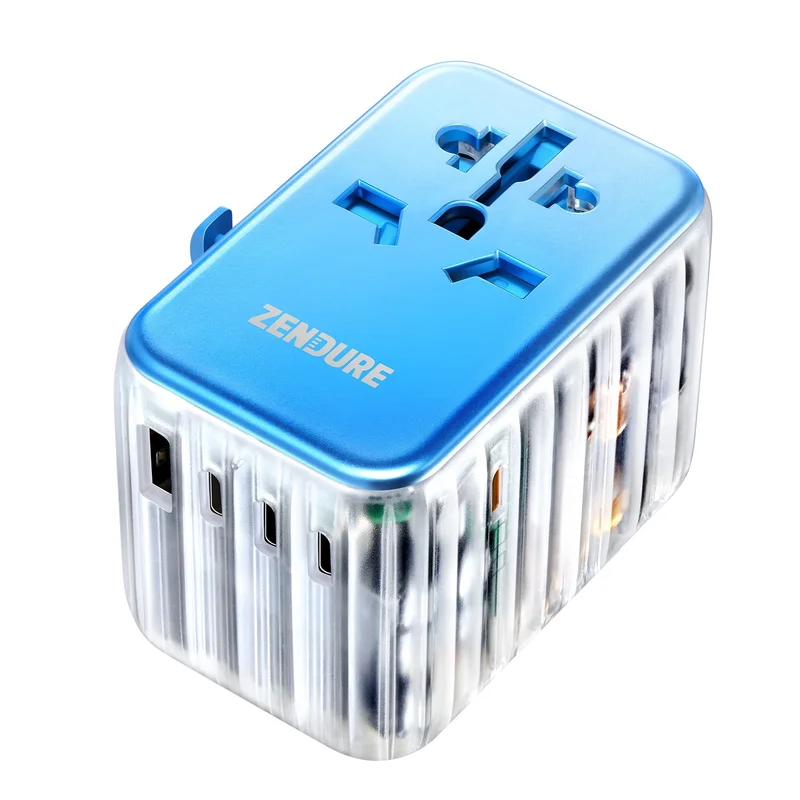
Photo: Zendure
The Passport III is the pick if weight and safety matter more to you than raw wattage, which makes it the right choice for families and cautious packers. It is the lightest adapter here at 168 grams (5.93 oz), delivers 65W on its top USB-C port (enough for most 13-inch and 14-inch laptops), and carries five ports: four USB-C plus one USB-A. Its sliding prongs cover US, UK, EU, and Australia, and it lists compatibility with outlet types A through O across 200-plus countries.
Its real edge is safety engineering. It uses a 10-amp auto-resetting fuse that Zendure rates to recover up to 6,000 times, and its prongs are child-safe sliding contacts rather than exposed pins. The Gadgeteer’s 2026 travel-adapter roundup singled out exactly those features. In testing, it charged a MacBook Air M2 from 20 to 80 percent in under an hour while simultaneously charging an iPhone on a second USB-C port.
The honest negatives. Only the top USB-C port delivers the full 65W; the other three USB-C ports and the USB-A share just 15W, so this is a “charge one device fast, trickle the rest” design, not four full-speed ports. One caution worth stating plainly: this is Zendure’s Passport III, not Zendure’s separate “Universal Travel Adapter,” which drew overheating and melting complaints in one roundup. The Passport III is the safe one in the line. It is $59.99 on sale (regular $79.99).
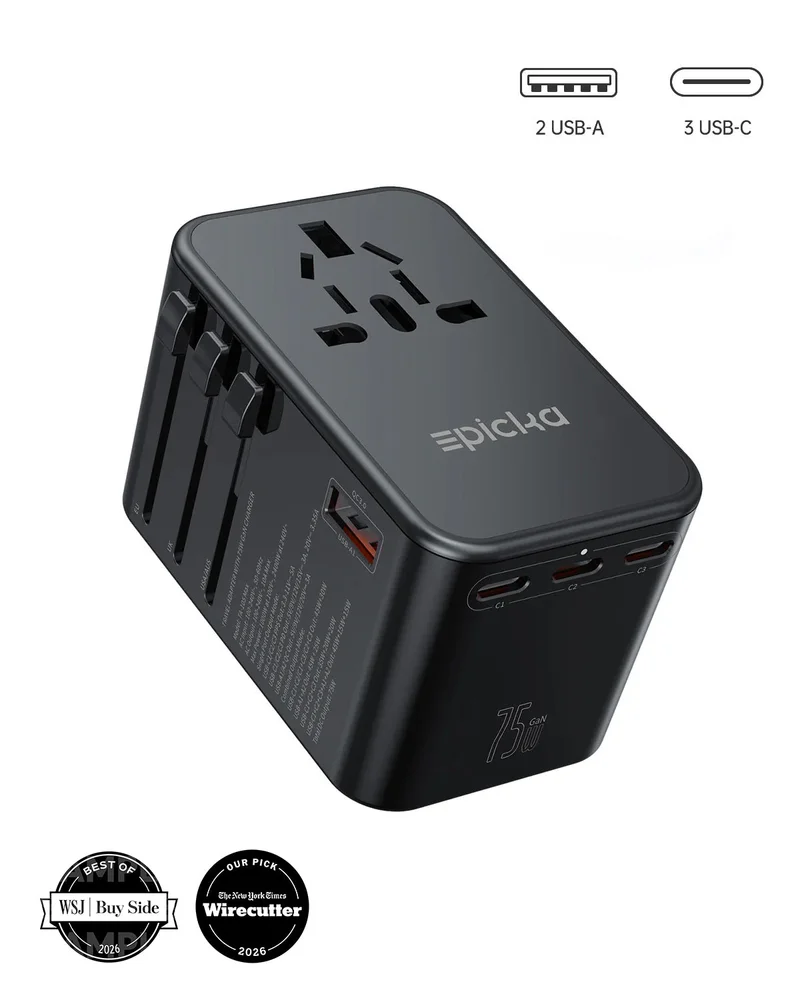
Photo: Epicka
The TA-105 Max is the pick if you want a touch more headroom than the Pro and do not mind carrying it. It bumps total output to 75W, with a single USB-C port reaching 67W (20V at 3.35A) and a USB-A port capable of 60W, across three USB-C and two USB-A ports. It shares the Pro’s four-plug coverage (EU, UK, US, Australia) across 200-plus countries.
The reason it is not the top pick is the trade you make for that extra headroom: it weighs 293 grams (10.34 oz), nearly 60 grams more than the Pro, for a wattage gain most travelers will never notice on a single laptop. If you are charging one laptop and a couple of small devices, the lighter Pro at a lower price is the smarter buy. Choose the Max only if you specifically want the highest single-unit ceiling here. It is $59.99, the same price as the Zendure but heavier.
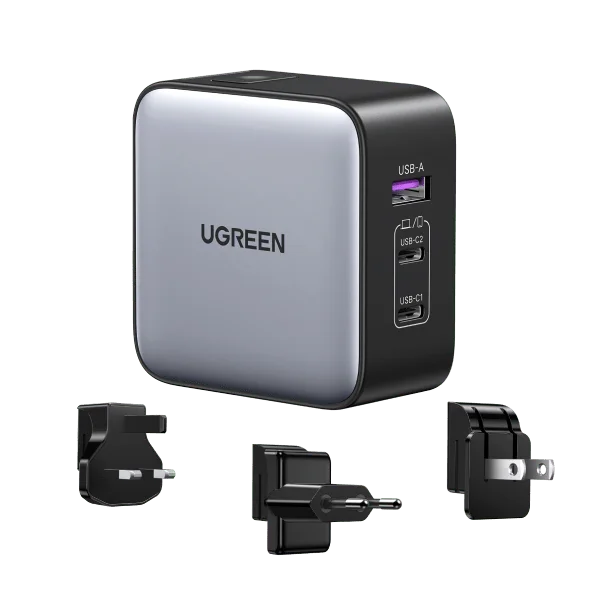
Photo: UGREEN
The Ugreen Nexode 65W Travel Charger is the pick for the traveler who wants the most compact, best-built body and does not need Australia. It delivers 65W on a single USB-C port, carries three ports (two USB-C and one USB-A), and supports the full range of fast-charging standards: PD 3.0, PPS, QC 4+ and 3.0, and SCP. Reviewers consistently praise Ugreen’s build quality and the sturdiness of its swappable plugs.
The honest negatives are two. It covers only US, UK, and EU plugs, with no Australia option, so it is a non-starter for a trip Down Under. And with three ports it holds fewer devices than the Epicka’s six or the Zendure’s five, so it suits a laptop-plus-phone traveler rather than someone charging a full kit. Ugreen does not list a weight on the product page. It is $56.00 (14 percent off at the time of writing).
Whichever you pick, remember the rule underneath all of them: the adapter changes the plug, not the voltage. Pack it for laptops, phones, and camera chargers, and leave the US hair dryer at home.
Compare eSIM coverage, data plans, prices, activation, and limits to choose an eSIM that fits your international trip.
Six offline maps apps compared for travel: Organic Maps, OsmAnd, HERE WeGo, Google Maps, Maps.me, and Gaia GPS. Which one belongs on your phone before you fly.
Verdict: For most travelers, Organic Maps is the app to install first: free, no ads, no tracking, and accurate to within 5 metres on foot. Add HERE WeGo if you are doing a road trip in Europe or the US. Add OsmAnd if you are hiking or cycling off-road. Google Maps offline is a decent backup but not a primary tool.
Real-time translation earbuds tested and ranked for travel: latency, offline support, accuracy, and price. Find the right pair for how you actually travel.
Verdict: For most travelers, the Timekettle W4 Pro ($449) is the only earbud that makes two-way conversation genuinely hands-free — one earbud per person, 0.2-second latency, no tapping required. Budget travelers who just need to get through airports and markets will do fine with the ANFIER M3 ($89.99), which handles 144 languages online and 8 offline for a fraction of the price.