Travel Power Strip: Turn One Hotel Outlet Into Six, Without Tripping a Cruise Ship Alarm
Verdict:The TESSAN 3-outlet cube ($25.99) is the travel power strip to pack for hotels and cruises: three outlets plus three USB ports off a 5-foot flat-plug cord, with no surge protection, which is exactly what cruise lines require. Going to Europe or the UK, take the TESSAN international version ($25.99) rated 100-250V with EU and UK plug heads included. The Anker 521 ($39.99 list) is the upgrade for a 30W USB-C port and Anker's safety system, for US-voltage trips.
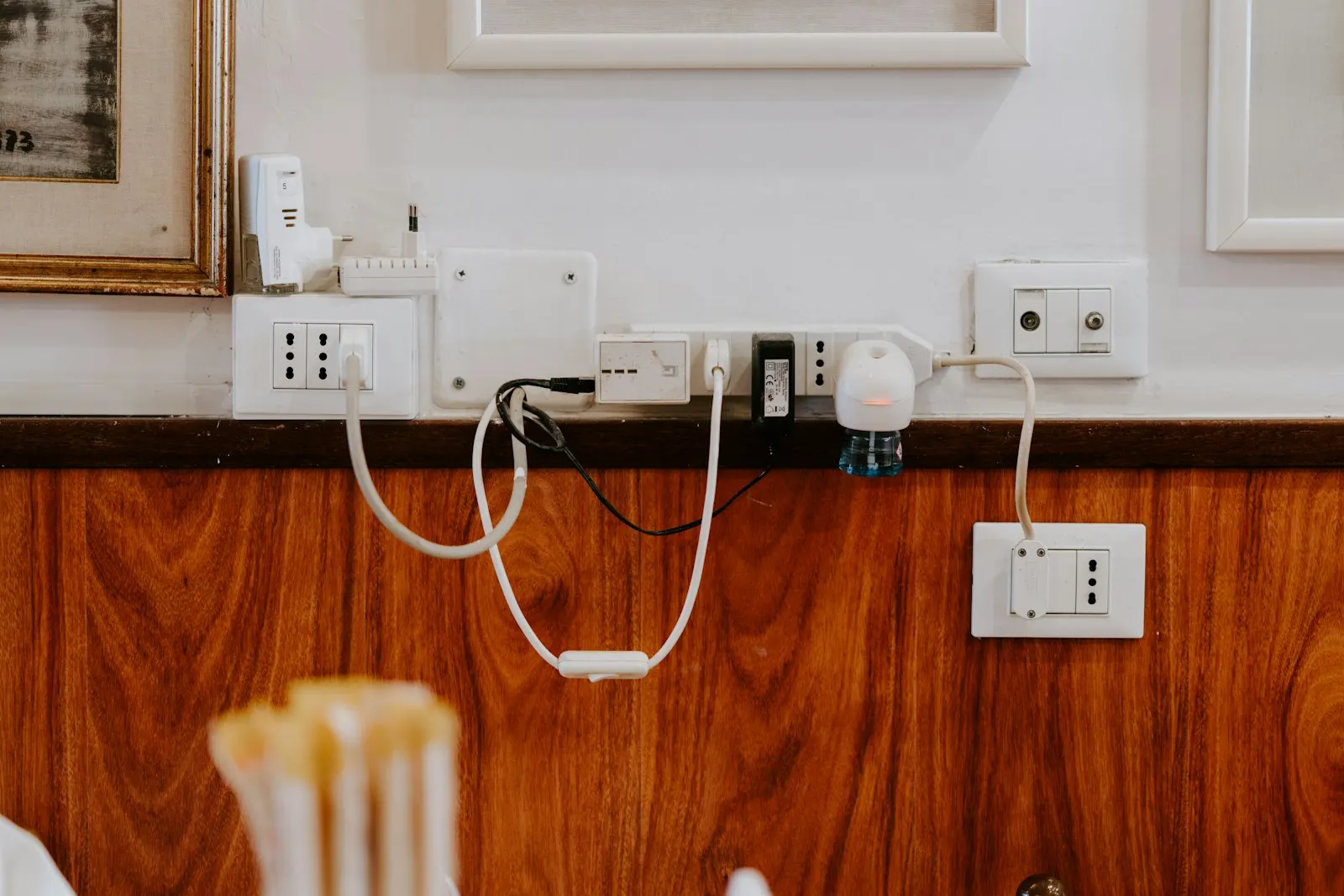
Every traveler eventually meets the hotel room with one reachable outlet, located behind the headboard, already occupied by the lamp. A travel power strip is the cheapest fix in all of travel tech: one plug in the bad outlet, and your phone, watch, earbuds, laptop, and camera all charge overnight. The catch is that power strips are also where travelers make their two most expensive electrical mistakes, so this guide covers the gear and the two rules.
Some links in this article are affiliate links. If you buy through them, we earn a small commission at no extra cost to you. We only link to products we would actually recommend.
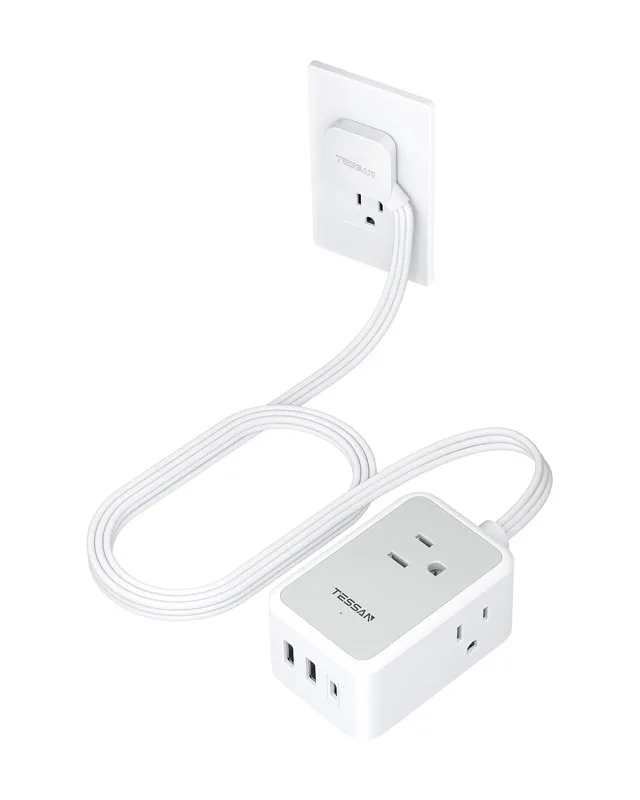
This is the pick for hotels, cruises, and anywhere on North American voltage. The cube is barely bigger than a plum at 3.07 by 2.04 by 1.46 inches and 0.59 lbs, and it carries three AC outlets spread across three faces so bulky adapters do not block each other, plus two USB-A ports and one USB-C. The cord is 5 feet with an ultra-slim 0.12-inch flat plug that fits behind furniture, which is where hotel outlets live. It costs $25.99 at TESSAN.
The spec that sounds like a flaw is the point: it has no surge protection. Cruise lines including Carnival and Royal Caribbean ban surge-protected power strips on board, because a tripped MOV on a ship’s electrical system is a fire risk, and confiscation at embarkation is routine. A no-surge strip like this one is the version that sails.
The honest negatives: the USB section is slow, 15W total across all three ports, so a modern phone fast-charges only from the AC side with its own brick. And the unit is rated 125V, so it is wrong for Europe. For that, read on.
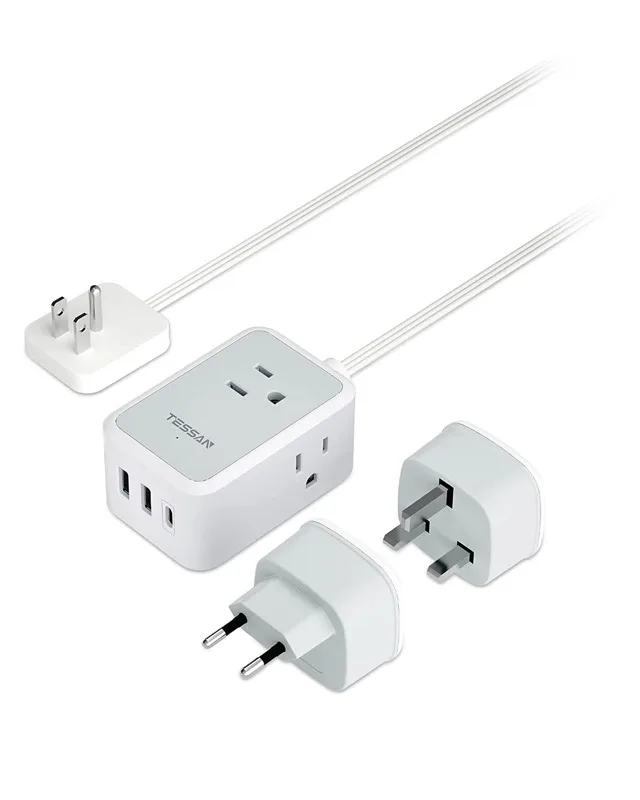
This is the pick for Europe and the UK, and the difference is one line on the spec sheet: it is rated 100-250V, 10A. Same cube idea, three outlets across three faces plus two USB-A and one USB-C, on a 5-foot cord, but the wall end takes interchangeable plug heads, with Type C for most of continental Europe and Type G for the UK and Ireland in the box, plus the US head. One unit, one adapter problem solved for the whole group of devices, $25.99.
Pair it with the right wall strategy: the strip handles the plug shape and your device chargers handle the voltage, because nearly every modern USB brick and laptop charger is dual-voltage. TESSAN prints the warning on the listing and it bears repeating: this is not a voltage converter. A US-only hair dryer plugged into it in Paris will still die loudly.
The honest negatives: same slow 15W shared USB output as its sibling, and it is frequently out of stock at TESSAN directly, so plan the purchase ahead of the trip rather than the night before.
This is the pick if you want real USB-C charging built into the strip, for travel inside North America. The 521 carries three AC outlets, two USB-A ports, and one USB-C port that delivers up to 30W with Power Delivery, enough to fast-charge a phone or keep a tablet full, so you can leave one charging brick at home. It runs a 5-foot cord, weighs 10.6 ounces at 4.57 by 1.97 by 1.28 inches, and Anker’s official support documentation lists 100-240V input and the company’s ActiveShield safety system with temperature monitoring and short-circuit protection. List price is $39.99 and it is routinely discounted well below that.
Note the cruise caveat cuts the other way here: the 521 includes 300 joules of surge protection, which is what you want in a hotel and what cruise security screens for. Hotels yes, ships no.
The honest negatives: Anker has rotated the 521 out of its own storefront in favor of newer charging stations, so you are buying through third-party retail where stock and price bounce around. We ship this section without a manufacturer product image for that reason rather than substitute a lookalike.
Rule one: voltage is about your device, not the strip. A power strip passes through whatever the wall provides, 120V in North America, 230V in most of Europe. Check the fine print on each charger you own: “Input: 100-240V” means it is safe anywhere with just a plug adapter. Single-voltage devices, mostly hair tools and cheap appliances, need an actual converter or they need to stay home. Our USB-C travel adapter guide covers the one-device alternative for USB-only packers.
Rule two: match the surge protection to the destination. Surge protection in hotels, none on ships. If you only buy one strip and you cruise, buy the no-surge TESSAN and add a quality USB wall charger like the ones in our iPhone travel charger guide for fast charging. And whatever you plug in, the overnight phone charge belongs on a power bank on travel days instead, because the best power strip in the world is useless on a train.
Airalo vs Holafly compared on real USD prices for Japan, Thailand, and Vietnam, daily data caps, hotspot rules, and who each eSIM is right for.
Verdict: Buy Airalo for most trips: it was cheaper than Holafly on every unlimited duration we checked in Japan, Thailand, and Vietnam, it sells fixed-GB plans that cost far less for light use, and it publishes its daily full-speed cap. Buy Holafly only if you want unlimited data sold by the exact day, from 1 to 90 days, and accept paying from $0.50 to about $25 more.
Airalo vs Saily compared on live prices, coverage, calls, apps, support, and Trustpilot scores, with a clear pick for each kind of trip.
Verdict: Airalo is the better default because its prices match Saily's almost to the cent and it adds calls and SMS plans, 3 to 365 day validity, and wider regional coverage. Saily is the better pick if you want a single reusable eSIM, faster in-app support, and a much higher Trustpilot score (4.7 against 4.1).
Anker power bank review for travelers: Laptop 25K 165W, Prime 26K 300W, MagGo 10K Slim and Nano 5K compared by weight, price, Wh, and the recall list.
Verdict: For most travelers carrying a laptop, the Anker Laptop Power Bank (25K, 165W) is the Anker to buy, because it pairs 92.5Wh of capacity with two built-in cables for $119.99. If you only charge an iPhone, buy the MagGo 10K Slim or the Nano 5K instead.