Best Mirrorless Camera for Travel in 2026: Four Bodies Worth the Lens Swap
Verdict:For most travelers, the Sony a6700 is the best mirrorless camera for travel: a 26MP APS-C sensor, 759 autofocus points, 4K/120p video, and a sealed body for $1,399 at launch. Pick the Fujifilm X-T50 if weight matters most, or the OM System OM-5 Mark II if you shoot in the rain.
The Sony a6700 is the best mirrorless camera for travel for most people, because it pairs a 26-megapixel APS-C sensor with the best autofocus in this group, a sealed body, and a price that launched at $1,399. If you care more about the weight on your shoulder than about autofocus, the Fujifilm X-T50 weighs 438 grams with battery and card. If you shoot in the rain, the OM System OM-5 Mark II is rated IP53 and starts at $1,049.99.
A mirrorless body is only half the pack. You are choosing a lens system too, and the lens you carry on day three decides whether the camera stays in your bag. This guide ranks four bodies by what they weigh, what they cost, and where each one lets you down. If you would rather have a fixed lens in your pocket, read our best travel camera guide instead.
Some links in this article are affiliate links. If you buy through them, we earn a small commission at no extra cost to you. We only link to products we would actually recommend. If it does not hold up in real use, it is not here.
Specs and prices were checked on October 12, 2026 against each maker’s page where it would load, and against DPReview’s reviews where it would not. Sony’s and Canon’s sites block automated checks, so Sony figures are DPReview’s launch numbers. Street prices move, so confirm before you buy.
What makes a mirrorless camera good for travel
Three things decide it, and megapixels are not one of them.
Body plus lens weight. The body is the smaller number. The Fujifilm X-T50 is 438 g with battery and card, and DPReview lists its 16-50mm kit lens at about 240 g, so the working kit is roughly 680 g. Swap in Fujifilm’s XF 27mm F2.8 R WR at 84 g and the same body is about 520 g.
Stabilization and sealing. Hand-held shots in dim cathedrals and night markets need in-body stabilization, and a rain shower in Lisbon is not the time to find out your body is unsealed.
Battery. The Fujifilm X-T50 is rated for 305 shots per charge on its screen and the Sony a6700 for about 570, so a day of heavy shooting can drain either one. Plan to carry a spare.
Camera
Sensor
Weight
Launch or list price
Weather sealing
Sony a6700
26MP APS-C
493 g (body)
$1,399 body
Sealed body
Fujifilm X-T50
40.2MP APS-C
438 g with battery and card
$1,399 body
Not listed by Fujifilm
OM System OM-5 Mark II
20.4MP 4/3-inch
418 g with battery and card
From $1,049.99
IP53
Sony a7C II
33MP full-frame
514 g with battery and card
$2,199 body
Dust and moisture resistant
Sony a6700
The a6700 is the camera to buy if you want one body that handles a market, a hiking trail, and a video clip of both. Its 26-megapixel APS-C sensor sits behind 5-axis in-body stabilization rated at 5.0 stops, and its autofocus uses 759 points covering 93 percent of the frame with subject recognition for people, animals, birds, and vehicles. It shoots 4K at 120p with a 1.58x crop, and its magnesium-alloy body is sealed at the joins.
DPReview scored it 88 percent and gave it a Gold award, calling it “one of the best enthusiast mirrorless cameras for the money in 2023.” Finding the Universe names it the top pick for most travelers and pairs it with the 18-135mm zoom as a one-lens travel kit.
The honest negatives. The design is chunky and utilitarian, there is no autofocus joystick, and the 2.36-million-dot viewfinder feels underwhelming at this price. DPReview’s travel guide also advises skipping the “really small 16-50mm” kit lens, which means budgeting for a better lens on top of the body. Launch pricing was $1,399 body only, $1,499 with the 16-50mm, and $1,799 with the 18-135mm, and DPReview’s guide currently lists $1,398 at B&H.
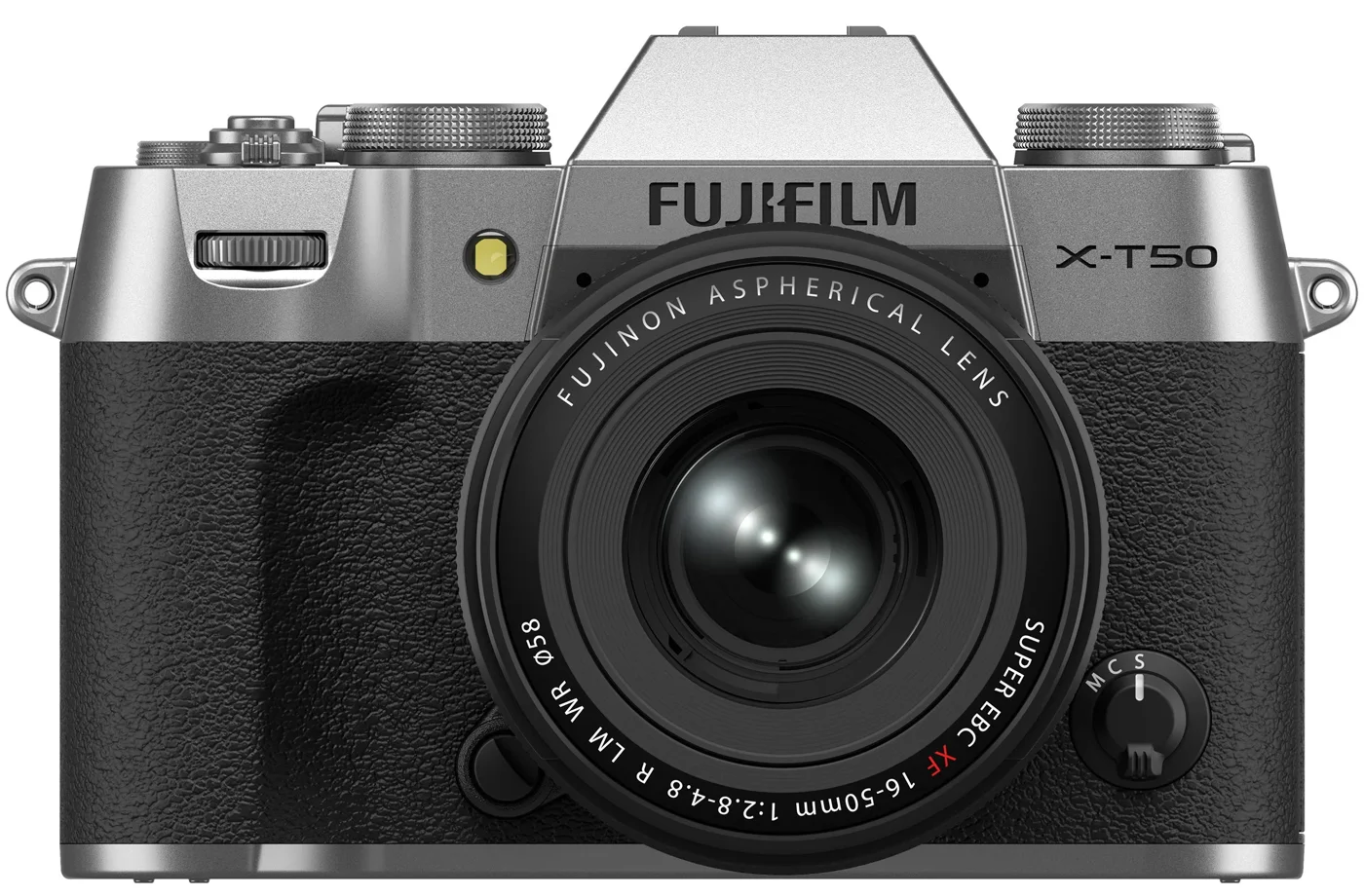
The X-T50 is the pick for the traveler who wants a small body that is fun to use. It packs a 40.2-megapixel X-Trans sensor, up to 7.0 stops of in-body stabilization, and 6.2K/30p video into 438 grams with battery and card. A dedicated dial gives you 20 film simulation modes, so you can get a finished look straight out of the camera and skip editing on the road.
DPReview scored it Silver, praising “great image quality and a fun dial” and its compact, portable size and weight. It also notes that Fujifilm’s primes are affordable and relatively fast, which is how you keep the kit small: pair the body with the 84 g XF 27mm F2.8 R WR and it is a street camera that fits a jacket pocket.
The honest negatives. DPReview says the autofocus tracking is “a step behind its peers” and trails the a6700, the viewfinder is tiny at 0.62x, and battery life is a short 305 shots per charge on the screen. Fujifilm’s page does not list weather sealing for the body, so treat it as unsealed and carry a rain cover. Launch pricing was $1,399 body only and $1,799 with the 16-50mm F2.8-4.8.
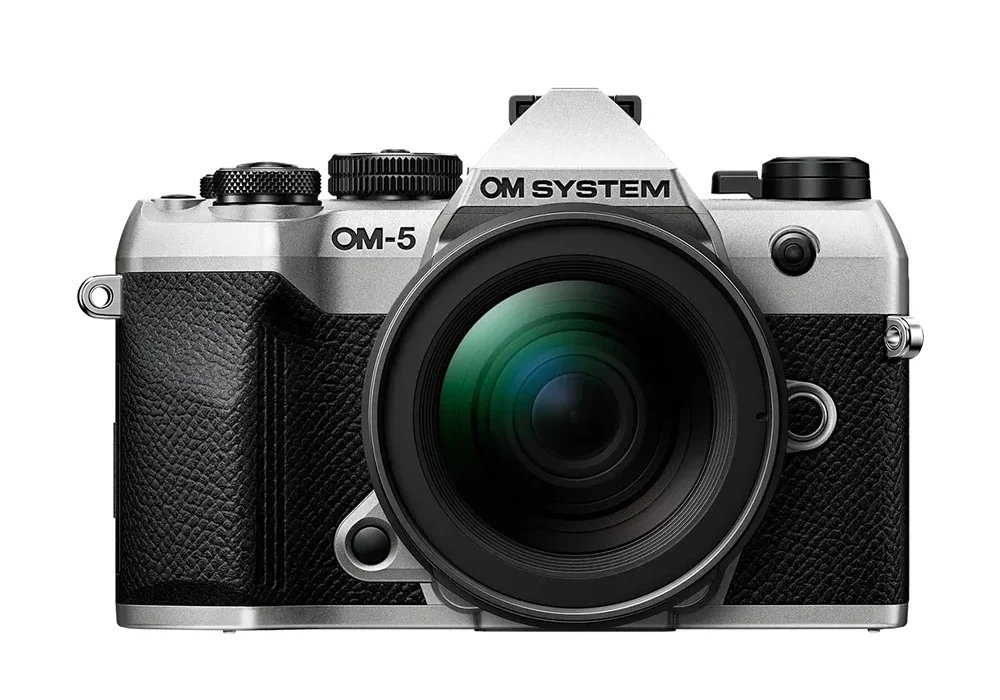
The OM-5 Mark II is the pick for the traveler who is going somewhere wet. OM System rates it IP53 weather sealed, gives it up to 7.5 stops of stabilization with a Sync IS lens, and keeps the body to 418 grams with battery and card (366 grams body only). It starts at $1,049.99, the lowest price of the four, and its 20.4-megapixel sensor is a smaller 4/3-inch format, which also means smaller lenses.
The Cotswold Photographer’s roundup describes the sister OM-3 as small and light, with generally smaller lenses, which is the real travel advantage of this format. The OM-5 Mark II shoots 4K at 30p.
The honest negatives. A smaller sensor gives up some low-light performance, and the Cotswold Photographer puts the sister OM-3 at about half to two-thirds of a stop behind Fujifilm APS-C in low light. The video tops out at 4K/30p, so it is not the camera for high-frame-rate clips. If you want a higher-spec body from the same maker, the OM-3 is from $1,799.99, weighs 496 grams with battery and card, and adds Live ND filters up to ND64.
The a7C II is the pick for the traveler who wants full-frame image quality in a body about the size of the APS-C cameras above. It has a 33-megapixel full-frame sensor, 7 stops of in-body stabilization, and 759 autofocus points with subject recognition like the a6700’s, in a body that weighs 514 grams with battery and card. DPReview’s summary is “small camera, little compromise,” and it scored the camera 87 percent.
The honest negatives. It launched at $2,199 body only and $2,499 with the 28-60mm kit lens, which is $800 more than the a6700, and DPReview lists a low-resolution viewfinder and screen, no autofocus joystick, and a higher price than its peers among the cons. DPReview also notes the compact size is part of the premium. Its travel guide makes the same point about the a7CR: choose lenses carefully to keep a full-frame kit portable.
Skip the kit lens first. DPReview’s guide advises against Sony’s smallest 16-50mm and says of the Fujifilm that you should consider “a lens that won’t limit it right out of the box.” In our view, a better lens usually improves your photos more than a body upgrade does.
Skip a tripod you will not carry. If you do shoot at night, our Peak Design Travel Tripod review covers a tripod that packs to the size of a water bottle.
Skip the bigger system if you are new to photography. Our guide to travel cameras for beginners compares entry-level bodies and what to check before you buy.
Which one should you buy?
If you want one body that does everything, buy the Sony a6700. Best autofocus and 4K/120p, from $1,399, once you add a better lens than the kit zoom.
If weight decides your pack, buy the Fujifilm X-T50. 438 g with battery and card, and 520 g with the 84 g 27mm lens, if you accept slower autofocus.
If you shoot in rain or on trails, buy the OM System OM-5 Mark II. IP53 sealing and 7.5-stop stabilization from $1,049.99, with a smaller sensor.
If you want full-frame in a small body, buy the Sony a7C II. 33MP and 514 g, at $2,199, and budget for larger lenses.
Airalo vs Holafly compared on real USD prices for Japan, Thailand, and Vietnam, daily data caps, hotspot rules, and who each eSIM is right for.
Verdict: Buy Airalo for most trips: it was cheaper than Holafly on every unlimited duration we checked in Japan, Thailand, and Vietnam, it sells fixed-GB plans that cost far less for light use, and it publishes its daily full-speed cap. Buy Holafly only if you want unlimited data sold by the exact day, from 1 to 90 days, and accept paying from $0.50 to about $25 more.
Airalo vs Saily compared on live prices, coverage, calls, apps, support, and Trustpilot scores, with a clear pick for each kind of trip.
Verdict: Airalo is the better default because its prices match Saily's almost to the cent and it adds calls and SMS plans, 3 to 365 day validity, and wider regional coverage. Saily is the better pick if you want a single reusable eSIM, faster in-app support, and a much higher Trustpilot score (4.7 against 4.1).
Anker power bank review for travelers: Laptop 25K 165W, Prime 26K 300W, MagGo 10K Slim and Nano 5K compared by weight, price, Wh, and the recall list.
Verdict: For most travelers carrying a laptop, the Anker Laptop Power Bank (25K, 165W) is the Anker to buy, because it pairs 92.5Wh of capacity with two built-in cables for $119.99. If you only charge an iPhone, buy the MagGo 10K Slim or the Nano 5K instead.