Bose QuietComfort Ultra Headphones Review for Travel: The Comfort Is Real, the ANC Lead Is Smaller Than the Price
Verdict:The Bose QuietComfort Ultra Headphones (2nd Gen) are worth $449 if comfort over a 10-hour flight is your priority, because the fit and weight are the best of the flagship group. If ANC depth matters more, buy the Sony WH-1000XM6 instead.
The Bose QuietComfort Ultra Headphones (2nd Gen) are worth $449 if comfort over a 10-hour flight is the priority, because the fit is the best in the flagship group and the ANC is still among the strongest you can buy. If noise cancelling depth matters more to you, the Sony WH-1000XM6 is the better buy at about the same price.
This review covers the current 2nd gen model, which Bose sells for $449. It leans on Bose’s own product page and independent testing from SoundGuys, Headphones.com, T3, and Audio Reviews, plus one first-generation review from LB Tech Reviews, which we flag where we use it. We did not get a unit for this article, so everything here traces to those sources, not our own in-flight testing.
Some links in this article are affiliate links. If you buy through them, we earn a small commission at no extra cost to you. We only link to products we would actually recommend. If it does not hold up in real use, it is not here.
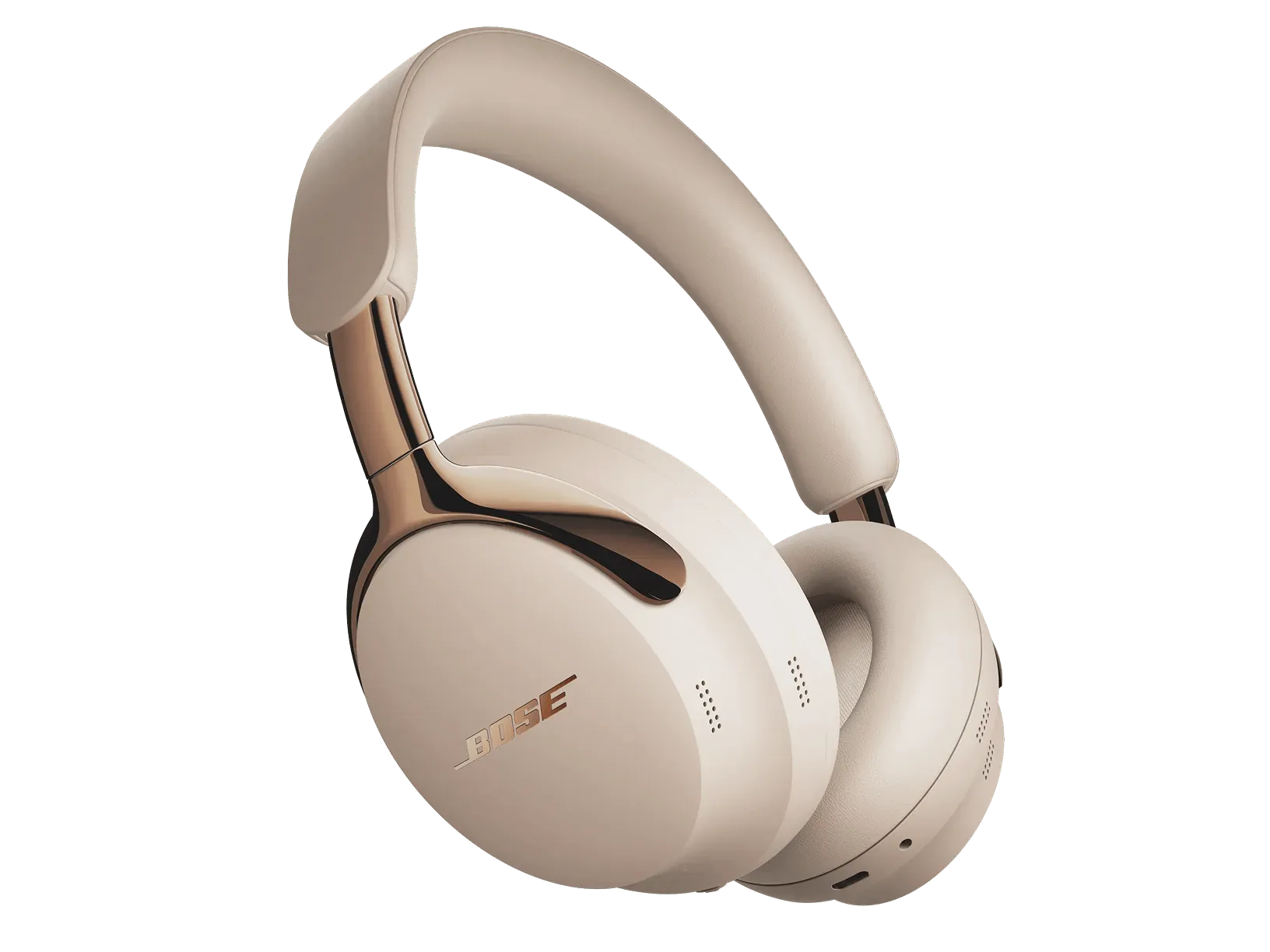
Bose lists the headphones at 0.583 lb, about 264 grams, with up to 30 hours of battery, or 23 hours with Immersive Audio on. A 15-minute quick charge buys 3 hours of playback, and a full charge takes 3 hours. It runs Bluetooth 5.4, plays lossless audio over USB-C, and the box includes a carry case, a 3.5 mm to 2.5 mm cable, and a 39-inch USB-C cable. Modes are Quiet, Aware, Immersion, and Cinema, and the warranty is one year.
On a flight, the useful part is not the spec sheet. It is that the headphones are comfortable. SoundGuys scores comfort 9.0 and calls them “a rather comfortable set.” Headphones.com calls the comfort “class-leading” and finds them lighter and more comfortable on long flights than the Sennheiser HDB 630 and Focal Bathys. LB Tech Reviews found the first generation “exceptionally comfortable to wear,” fitting “snugly but don’t pinch” and working with glasses.
How the noise cancelling holds up
The ANC is very good, but the evidence that it leads the group is thin. SoundGuys scores it 8.7 out of 10 and found gross noise attenuation essentially unchanged from the first generation. Audio Reviews says the noise cancelling “still beats all other ANCs I have tested by miles,” although an inexpensive TOZO HT3 “comes alarmingly close” on steady noise like a dryer or vacuum.
The caveat is the comparison with Sony. LB Tech Reviews measured the first generation against the Sony WH-1000XM5 and found it “clearly lets less noise through, in several places around 15-20 dB less” on the Sony. That is one reviewer’s measurement, and it covers the earlier Bose against the earlier Sony, so treat it as a direction, not a verdict. SoundGuys prices the 2nd gen “right in line with” the Sony WH-1000XM6, which is the comparison that matters now.
T3 went further. In a side-by-side test against the original, T3 called the 2nd gen a step backward on ANC and said it lets some higher frequencies through that the first generation did not. Headphones.com says overall attenuation is not higher than before, but that the ANC “better prioritizes acute, sudden noises.” If you are choosing between generations, the 1st gen is the better value if you can find it on sale, and Headphones.com does not consider the 2nd gen a must-upgrade.
Battery in the real world
Bose’s page says 30 hours, or 23 with Immersive Audio. SoundGuys measured 27 hours 12 minutes with ANC on. Either way, you cross a 14-hour flight without worrying, and a Sydney to London routing needs one top-up at most. Turn Immersive Audio off for a long-haul if you want the full figure, since Bose itself lists a 7-hour drop with it on.
Where it falls short
Call quality is average. In a reader poll of 1,453 votes, SoundGuys found 53 percent rated the mic Good or Excellent and 11 percent Bad or Awful. LB Tech Reviews said the first generation’s voice sounded “highly compressed and sounds processed.”
The default sound needs work. Headphones.com calls the default tuning “heavy-handed” and found it excellent only after turning bass down in the app. SoundGuys notes the in-app EQ is “too simplistic.”
Connection and codec limits. SoundGuys lists “some connection issues,” and iPhone users are limited to SBC and AAC. aptX Adaptive needs a Snapdragon 8 Gen 3 or newer Android phone.
They run warm. SoundGuys’ main comfort complaints are heat buildup and ears touching the padding over long sessions.
No water resistance. There is no IP rating, so keep them out of a wet bag pocket.
The battery is not replaceable. Audio Reviews criticizes this.
If comfort over a 10-hour or longer flight comes first, buy the Bose QuietComfort Ultra Headphones (2nd Gen). Fit and weight are the best of the group, and 30 hours of battery covers the longest routes, for $449.
If ANC depth comes first, buy the Sony WH-1000XM6 instead. SoundGuys measured up to 87 percent noise reduction on it, and it sells at about the same price.
If you want Bose comfort for less, look for the first-generation QuietComfort Ultra on sale. The ANC is essentially unchanged, and T3 found the original’s higher frequencies handled better.
If you are all-iPhone and care about codecs, check the AAC limit first. Lossless audio only works over USB-C, not Bluetooth.
Airalo vs Holafly compared on real USD prices for Japan, Thailand, and Vietnam, daily data caps, hotspot rules, and who each eSIM is right for.
Verdict: Buy Airalo for most trips: it was cheaper than Holafly on every unlimited duration we checked in Japan, Thailand, and Vietnam, it sells fixed-GB plans that cost far less for light use, and it publishes its daily full-speed cap. Buy Holafly only if you want unlimited data sold by the exact day, from 1 to 90 days, and accept paying from $0.50 to about $25 more.
Airalo vs Saily compared on live prices, coverage, calls, apps, support, and Trustpilot scores, with a clear pick for each kind of trip.
Verdict: Airalo is the better default because its prices match Saily's almost to the cent and it adds calls and SMS plans, 3 to 365 day validity, and wider regional coverage. Saily is the better pick if you want a single reusable eSIM, faster in-app support, and a much higher Trustpilot score (4.7 against 4.1).
Anker power bank review for travelers: Laptop 25K 165W, Prime 26K 300W, MagGo 10K Slim and Nano 5K compared by weight, price, Wh, and the recall list.
Verdict: For most travelers carrying a laptop, the Anker Laptop Power Bank (25K, 165W) is the Anker to buy, because it pairs 92.5Wh of capacity with two built-in cables for $119.99. If you only charge an iPhone, buy the MagGo 10K Slim or the Nano 5K instead.